
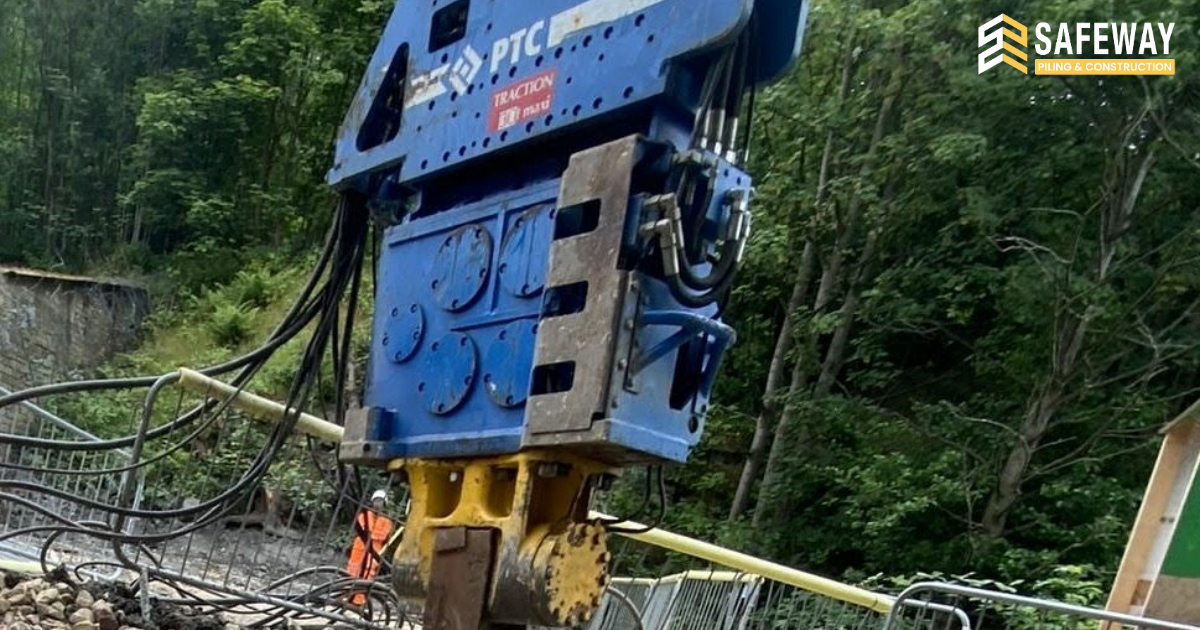
What Is a Vibratory Hammer?
A vibratory hammer is a type of pile-driving equipment that uses controlled vibrations to push piles into the ground or pull them out. The machine usually connects to the top of a pile through a hydraulic clamp. A crane or a suitable excavator supports the hammer during operation. Unlike an impact hammer, which drives piles through repeated blows, a vibratory hammer generates continuous oscillating forces. These forces reduce resistance along the pile surface and help it penetrate the soil under suitable ground conditions.
Contractors commonly use vibratory hammers for steel sheet piles, steel pipe piles, H-piles, and temporary casings. The correct machine depends on the pile dimensions, soil profile, required installation depth, and project specifications.
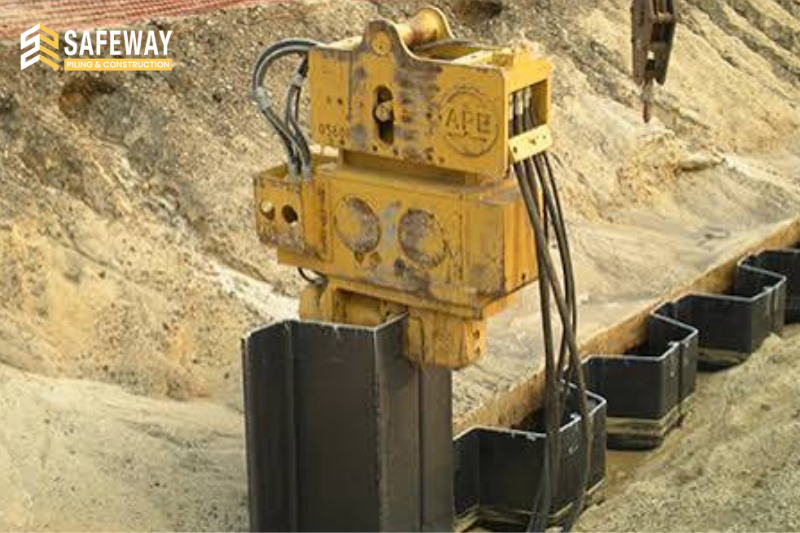
How Does a Vibratory Hammer Work?
A vibratory hammer works through rotating eccentric weights inside its gearbox. These weights rotate to create rapidly changing forces that produce vertical vibrations. A hydraulic clamp transfers the vibrations to the pile, helping it move through the soil. The installation process involves several important steps. These are given below:
Step 1: Positioning the Pile: Workers place the pile at the approved installation point and align it vertically using suitable lifting equipment and guides. Proper positioning helps prevent the pile from moving away from its planned location.
Step 2: Connecting the Hammer: The operator lowers the vibratory hammer and attaches its clamp securely to the pile head. The clamp must match the pile profile and have enough capacity to hold the pile safely during installation.
Step 3: Starting the Vibration System: The hydraulic power pack supplies pressurised oil to the hammer’s hydraulic motor. The motor rotates the eccentric weights inside the gearbox, creating the forces that generate vibration.
Step 4: Reducing Soil Resistance: The vibration transfers from the hammer to the pile and then into the surrounding soil. In suitable granular soils, such as sand, this movement can reduce friction along the pile surface and make penetration easier.
Step 5: Driving the Pile into the Ground: The combined effect of vibration, the weight of the hammer and pile, and any suitable applied force helps the pile move downward. The operator monitors the penetration rate, pile alignment, and equipment performance throughout the process.
Step 6: Checking the Required Depth: The operator continues driving until the project requirements are met. Engineers then verify the installation depth and other specified acceptance criteria. Penetration speed alone does not prove that a permanent foundation pile has the required load capacity.
Main Components of a Vibratory Hammer
A vibratory hammer contains several components that work together to produce vibration and transfer it to the pile. Understanding these parts helps engineers and contractors select suitable equipment.
Eccentric Weights: These rotating masses create the oscillating forces needed for pile driving. Their arrangement and operating speed influence the hammer’s vibration characteristics.
Gearbox or Exciter Unit: The gearbox houses the rotating weights and their synchronization mechanism. It controls the movement of the weights and transfers the generated forces to the hammer assembly.
Hydraulic Motor: The hydraulic motor converts energy from pressurized hydraulic fluid into rotational movement. This movement drives the eccentric weights and produces the required vibration.
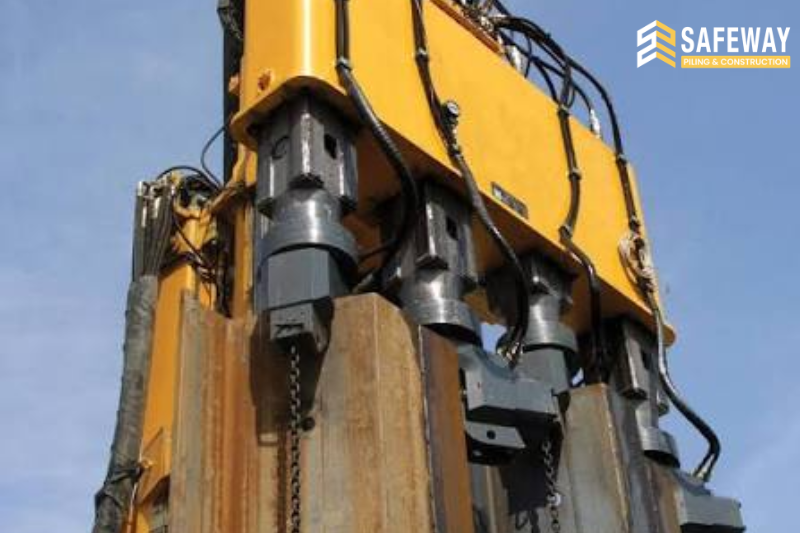
Hydraulic Clamp: The clamp grips the pile head and transfers vibration from the hammer to the pile. It must match the pile dimensions and have the correct capacity for the installation work.
Hydraulic Power Pack: The power pack supplies the hydraulic pressure and oil flow required to operate the hammer. Some systems use a separate power pack, while compatible excavator-mounted models may use the carrier’s hydraulic system.
Crane or Excavator: A crane suspends and positions many vibratory hammer systems. Some smaller or specially designed hammers attach directly to excavators. The supporting machine must have sufficient capacity for the hammer, pile, lifting accessories, and operating loads.
Types of Vibratory Hammers Used in Construction
Different vibratory hammers suit different projects, soil conditions, and installation requirements. Engineers should compare equipment specifications before selecting a machine.
Hydraulic Vibratory Hammer: This type uses hydraulic power to rotate the eccentric weights and generate vibration. Contractors commonly use it for steel sheet piles, steel pipes, and suitable pile extraction work.
High-Frequency Vibratory Hammer: This hammer operates at a relatively high vibration frequency. Some models offer controlled starting and stopping to help manage vibration near sensitive structures. Actual performance depends on the machine design and ground conditions.
Low-Frequency Vibratory Hammer: This type operates at a lower frequency and may provide a higher vibration amplitude, depending on its design. Contractors may consider it for heavier piles or applications requiring a different balance of force and vibration.
Variable-Moment Vibratory Hammer: This type allows operators to adjust the eccentric moment on suitable models. Some machines can start and stop with reduced vibration by changing the eccentric setting, which can help manage vibration during operation.
Where Is a Vibratory Hammer Used?
Vibratory hammers support several construction activities, especially where contractors need to install or remove suitable steel piles.
Sheet Pile Installation: Contractors use vibratory hammers to install interlocking steel sheet piles for retaining walls, excavation support, cofferdams, and riverbank protection. The piles form a continuous wall that retains soil or supports temporary construction works.
Basement Construction: Deep basement projects often require retaining systems to support the surrounding ground during excavation. A vibratory hammer can install suitable sheet piles, depending on soil conditions, nearby structures, and the approved construction method.
Riverbank and Waterfront Protection: Steel sheet piles can help protect riverbanks and support waterfront structures. Vibratory installation may be suitable for these projects, but engineers must assess the soil, water conditions, nearby assets, and environmental requirements.
Steel Pipe and Casing Installation: Suitable vibratory hammers can install steel pipes and temporary casings for selected foundation and construction applications. The hammer and clamp must match the pipe dimensions and required installation conditions.
Pile Extraction: A vibratory hammer can also remove temporary sheet piles, steel sections, and suitable casings after construction work. Vibration reduces soil resistance around the pile, allowing lifting equipment to extract it when ground conditions permit.
Advantages of Using a Vibratory Hammer
Vibratory hammers offer several benefits when contractors choose the right equipment and installation method.
Faster Installation in Suitable Soils: Vibratory driving can install suitable piles efficiently, particularly in granular soils. Faster penetration can reduce installation time and improve productivity.
Reduced Impact Noise: Unlike conventional impact hammers, vibratory hammers do not rely on repeated heavy blows. They may reduce impact noise, although operating noise and ground vibration still require proper assessment.
Efficient Pile Extraction: Contractors can use vibration to loosen the soil around temporary piles and remove them after completing excavation or other construction work. Reusing recoverable piles may help reduce material waste.
Useful for Temporary Works: Vibratory hammers are commonly used for temporary sheet pile walls and cofferdams. Contractors can install and later remove the piles when the project design and ground conditions allow it.
Flexible Equipment Options: Different hammer types offer different operating characteristics. Engineers can compare frequency, eccentric moment, clamp capacity, and machine compatibility to find a suitable option for the project.
Vibratory Hammer vs. Impact Hammer
Both machines drive piles into the ground, but their operating principles differ.
| Feature | Vibratory Hammer | Impact Hammer |
| Working method | Continuous vertical vibration | Repeated impact blows |
| Soil interaction | Reduces soil resistance through vibration | Uses impact energy to drive the pile |
| Common applications | Sheet piles, suitable steel pipes, casings, and extraction | Various foundation piles and impact-driving applications |
| Noise | May reduce impact noise | Often produces significant impact noise |
| Soil suitability | Often effective in suitable granular soils | May be suitable for dense layers and specified driving requirements |
| Final acceptance | Requires project-specific checks | Requires project-specific checks |
Neither method is best for every project. The choice depends on the geotechnical report, pile design, required depth, nearby structures, and engineering requirements. Some projects use a vibratory hammer for initial installation and an impact hammer to complete driving where the design or specification requires it.
How to Choose the Right Vibratory Hammer
Selecting the correct vibratory hammer helps improve installation quality, equipment safety, and project efficiency. Engineers and contractors should evaluate several factors before starting work.
Soil Conditions: Review the geotechnical investigation to identify soil layers, density, groundwater conditions, and possible obstructions. Vibratory driving often performs well in granular soils, while stiff clay or very dense layers may require a different method.
Pile Type and Dimensions: Check the pile length, width, weight, profile, and material. The hammer and clamp must match the pile and transfer the required forces without exceeding equipment limits.
Required Installation Depth: Consider the required depth, expected soil resistance, and pile characteristics. The engineering team should confirm the equipment’s suitability for the expected driving conditions.
Nearby Buildings and Structures: Ground vibration can affect adjacent foundations, underground services, roads, and sensitive equipment. Assess these risks before selecting the installation method and establish monitoring requirements where necessary.
Machine and Crane Capacity: Confirm that the supporting machine can safely handle the hammer, pile, lifting accessories, and operating loads. The hydraulic supply must also meet the manufacturer’s specifications.
Project Budget and Schedule: Compare equipment rental, transportation, mobilisation, operator requirements, fuel, maintenance, and expected installation time. The best option should meet project requirements while controlling avoidable costs.
What Engineers Should Know Before Using a Vibratory Hammer
Engineers should understand how soil conditions, pile specifications, vibration characteristics, and machine capacity affect vibratory hammer performance. Proper planning helps them select suitable equipment, maintain pile alignment, and reduce installation problems.
Soil Investigation and Ground Resistance: Engineers should review the geotechnical report to identify soil layers, groundwater levels, dense sand, stiff clay, and possible obstructions. These factors influence penetration speed and help determine whether vibratory driving is suitable for the project.
Vibration Frequency and Amplitude: Frequency refers to the number of vibration cycles per second, while amplitude describes the extent of the vibration movement. Engineers should consider both when selecting equipment because these characteristics influence how the hammer interacts with the pile and surrounding soil.
Eccentric Moment and Driving Force: The eccentric moment describes the effect of the rotating eccentric masses and their offset from the rotation axis. Together with operating frequency and equipment characteristics, it influences the force generated by the hammer. Engineers should review the manufacturer’s specifications rather than selecting equipment based on weight alone.
Pile Alignment and Interlock Connection: For sheet pile walls, engineers should monitor verticality and check that adjacent pile interlocks connect correctly during installation. Poor alignment can cause installation difficulties, gaps, and problems with the completed retaining wall.
Ground Vibration and Nearby Structures: Engineers should assess possible vibration effects on nearby buildings, roads, underground utilities, and sensitive structures. Where necessary, they should establish monitoring limits, review the results during installation, and consider alternative methods if vibration exceeds acceptable levels.
Installation Records and Quality Control: Engineers should record pile identification, installation depth, equipment details, alignment checks, unusual resistance, and relevant monitoring results. These records help the project team review installation quality and confirm compliance with the approved construction requirements.
Equipment Compatibility and Hydraulic Requirements: Engineers should verify that the hammer, clamp, crane or excavator, and hydraulic power supply work together within their rated limits. Incorrect equipment matching can reduce performance and create safety risks during installation.
Final Acceptance Requirements: Engineers should identify the required inspection, testing, and acceptance criteria before piling begins. For permanent foundation piles, they must follow the approved design and specified testing procedures because successful penetration alone does not establish load capacity.
Safety Measures During Vibratory Hammer Operation
Vibratory hammer operations require proper planning, trained operators, and suitable lifting equipment. Poor alignment, an unsuitable clamp, or incorrect operation can cause equipment damage and serious accidents.
Inspect the Equipment: Check the clamp, hydraulic hoses, connections, lifting points, and other components before operation. Remove defective equipment from service until the responsible team confirms it is safe.
Secure the Pile: Ensure that the clamp grips the pile correctly and that the lifting arrangement follows the manufacturer’s instructions. Keep workers away from suspended piles and hammers.
Maintain Proper Alignment: Use suitable guides and monitor the pile during driving. Stop work if the pile moves unexpectedly or the equipment becomes unstable.
Monitor Ground Vibration: Assess nearby buildings and sensitive structures before piling begins. Use vibration monitoring when required by the project risk assessment or applicable requirements.
Follow Operating Limits: Operate the hammer, crane, and hydraulic system within their approved limits. Only trained personnel should control the equipment and coordinate lifting activities.
Prepare an Emergency Plan: Establish communication signals, exclusion zones, and emergency procedures before work starts. The team should know how to respond to equipment failure, unexpected pile movement, or unsafe ground conditions.
Vibratory Hammer Services by Safeway Piling & Constructions
Safeway Piling & Constructions supports piling and foundation-related construction work where the correct equipment and installation method are essential. Vibratory hammers can play an important role in suitable sheet pile installation, excavation support, cofferdam construction, and temporary piling projects. Before selecting equipment, the project team should review the soil report, pile specifications, installation depth, site access, and nearby structures. This assessment helps determine whether vibratory driving is suitable or whether another piling method would better meet the project requirements.
For sheet piling and other foundation works, contractors should focus on safe equipment operation, correct pile alignment, and compliance with the approved design. These measures help improve work quality and reduce avoidable delays. If you are planning a sheet piling or foundation project in Bangladesh, contact Safeway Piling & Constructions to discuss your project requirements and suitable piling solutions.
Conclusion
A vibratory hammer is an important piece of piling equipment that uses rapid vertical vibrations to reduce soil resistance and install or extract suitable piles. Its main components include eccentric weights, a gearbox, a hydraulic motor, a clamp, and a hydraulic power supply.
The equipment can improve installation efficiency in suitable soil conditions and support projects involving sheet piles, steel pipes, excavation support, and temporary retaining walls. However, the correct hammer depends on the soil profile, pile design, required depth, and surrounding structures. Engineers should evaluate equipment capacity, vibration characteristics, pile alignment, and safety requirements before starting installation. For successful piling work, Safeway Piling & Constructions recommends choosing the installation method based on project requirements and following the approved engineering specifications.
Frequently Asked Questions (FAQs)
- What is a vibratory hammer used for?
A vibratory hammer is used to install and extract suitable steel sheet piles, steel pipes, H-piles, and casings. It is commonly used for excavation support, cofferdams, riverbank protection, and other piling applications.
- How does a vibratory hammer work?
It uses rotating eccentric weights to generate vertical oscillating forces. A clamp transfers these vibrations to the pile, reducing resistance between the pile and surrounding soil and helping the pile move into the ground.
- Can a vibratory hammer work in clay soil?
Yes, some vibratory hammers can operate in clay, but performance depends on clay strength, soil profile, pile design, and equipment capacity. Stiff clay may reduce penetration efficiency, so another driving method may be necessary.
- Is a vibratory hammer better than an impact hammer?
Neither method is best for every project. A vibratory hammer can offer efficient installation in suitable soils, while an impact hammer may be more appropriate when piles must penetrate dense layers or meet specific driving requirements.
- Can a vibratory hammer remove sheet piles?
Yes. A suitable vibratory hammer can loosen the soil around temporary sheet piles and help lifting equipment pull them out. Extraction depends on pile condition, soil resistance, embedment depth, and equipment capacity.
- Does a vibratory hammer cause ground vibration?
Yes. Although it does not use repeated impact blows, it still generates ground vibration. The project team should assess nearby structures and use appropriate monitoring and mitigation measures where necessary.
- What should engineers check before using a vibratory hammer?
Engineers should review soil conditions, pile dimensions, hammer capacity, vibration characteristics, crane compatibility, and nearby structures. They should also establish installation monitoring and acceptance requirements before work begins.
- Can a vibratory hammer install sheet piles in every soil type?
No. Vibratory driving is often effective in suitable granular soils, but dense layers, stiff clay, buried obstructions, or other challenging ground conditions may limit performance. Engineers should assess the site and select an appropriate installation method.